


Epoxy Resin Chlorine: Match the Analyte to the COA
Compare epoxy chlorine results by analyte, method and reporting basis. Keep grade notes, catalogue limits and lot COA results separate before acceptance.
A low-chlorine epoxy quotation is incomplete until it identifies which chlorine result is being promised. Ionic chlorine, hydrolyzable chlorine and a method-defined total are not interchangeable labels. A small number under the wrong heading cannot establish compliance with the buyer's requirement.
For purchasing, separate three records: the grade description, the agreed analytical specification and the offered lot's certificate of analysis (COA). The first helps select a candidate. The other two determine whether the reported result answers the agreed acceptance question.
Name the chlorine being measured
The public abstracts of ISO 21627-1, ISO 21627-2 and ISO 21627-3 identify different analytical scopes. They are useful for distinguishing the terms, not evidence that MOS uses those methods or that a complete laboratory procedure has been supplied.
| Report label | What must be identified | What it does not supply |
|---|---|---|
| Inorganic or ionic chlorine | The method's inorganic/ionic chloride determination and reporting basis | A measurement of all chlorine associated with the resin |
| Easily saponifiable chlorine; supplier wording may say hydrolyzable chlorine | The particular method, edition and treatment behind that label | Automatic equivalence to every other hydrolysis method, or to total chlorine |
| Total chlorine | The stated total method and the chlorine it determines; ISO 21627-3 describes a defined scope including saponifiable organic and inorganic chlorine | Proof that another “total” method has identical recovery, or that separate values can simply be added |
Keep the exact report wording. Do not silently translate “hydrolyzable” into “total,” or treat the name of a standard family as a complete method reference. Public scope summaries do not establish equivalence between two laboratories' procedures.
Read the grade claim without filling its gaps
The actual MOS Bisphenol F Epoxy Resin reference page illustrates the problem. DF170E carries a lower-total-chlorine grade note, while the numerical chlorine column is labelled hydrolyzable chlorine. The note does not supply a numerical total result, its method or an offered-lot measurement. Ask for those missing details if total chlorine is part of the purchase specification.
This is a document distinction, not a finding that the grade passes or fails. A catalogue limit is also different from an actual COA result. Retain both labels when copying information into the purchasing record; do not create a total-chlorine value by renaming the available field.
Osaka Soda's high-purity epoxy grade table reports hydrolyzable and total chlorine separately for named grades. That is an example of separate declarations, not a MOS specification, a grade-equivalence statement or proof that the methods are the same.
Reconcile the COA before accepting the lot
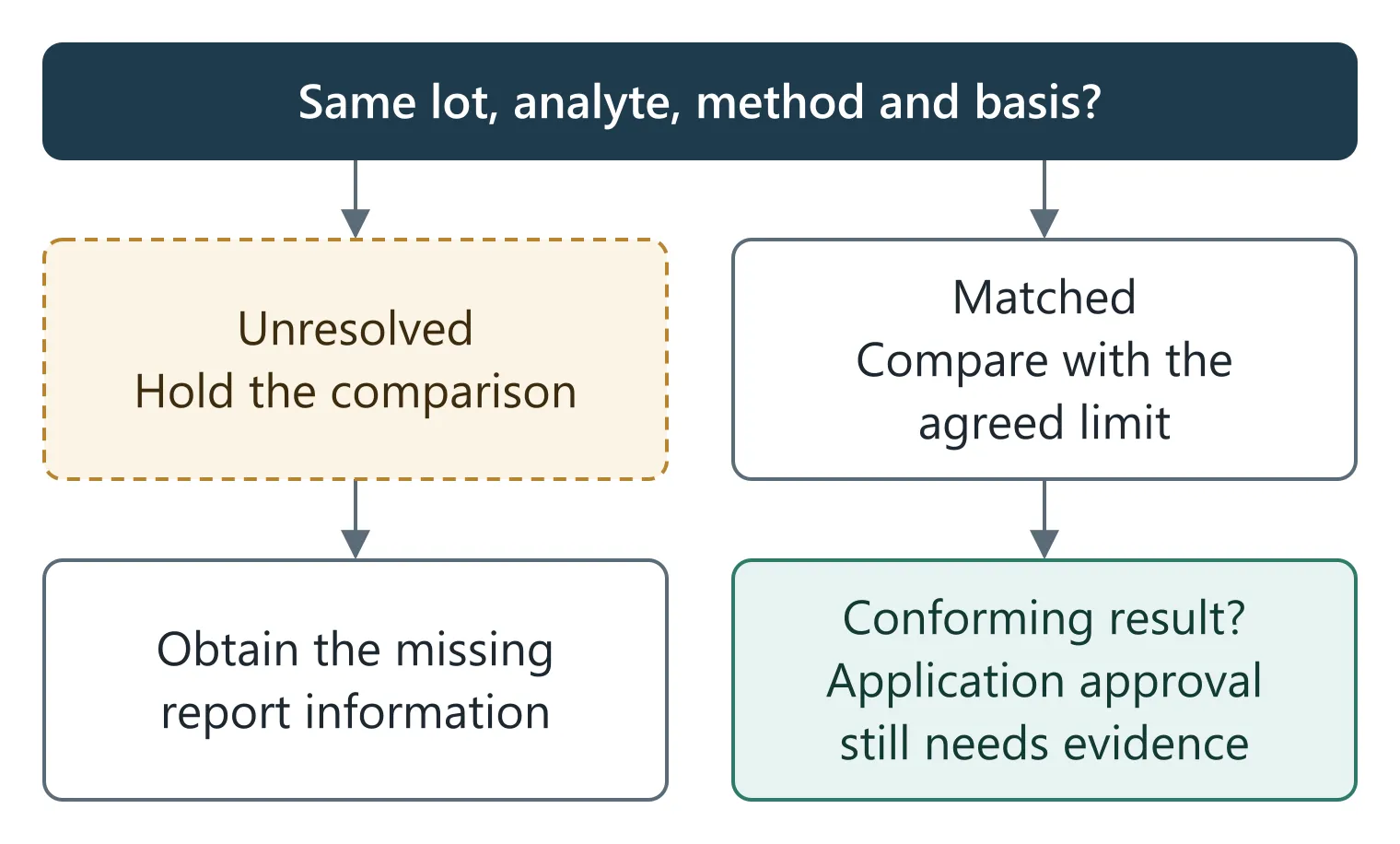
Begin with the exact resin grade and lot. Confirm whether the sample describes the supplied resin, a solution or another prepared material, and retain its reporting basis. Then match the analyte, method/edition, sample preparation and units to the agreed specification. Resolve a mismatch before ranking results or making a conformity decision.
Unit conversion is the last part of this match, not a cure for missing analytical information. As a dimensional example, 0.01% by mass equals 100 mg/kg on the same mass basis. That arithmetic neither changes hydrolyzable chlorine into total chlorine nor converts a solution-basis result into a neat-resin result. This example is not a MOS acceptance limit or a batch result.
Check how the laboratory reports a value below its quantification limit. “Not reported,” a dash and “below the reporting limit” do not mean the same thing; none should be copied as an exact zero. The reporting capability must also be adequate for the buyer's limit before that result can support the decision.
Do not reconstruct a total by adding fields merely because they all contain the word chlorine. Method scopes can overlap, and the results may not describe the same sample or basis. Ask the reporting laboratory to explain the relationship or obtain the required determination under an agreed method.
If the specified result is absent, the scope is unresolved or the reporting capability is inadequate, keep that acceptance decision on hold. If a comparable result does not meet the agreed limit, do not approve it by changing the label or borrowing a different grade's typical value. Even a conforming incoming result does not establish the cured system's corrosion resistance, electrical reliability or suitability for a particular application.
Carry the unresolved requirement into the enquiry
For a real grade enquiry, use the existing BPF resin product page. State the exact grade, intended use, required chlorine analyte, method and reporting basis, and the acceptance limit that must be met. Include the sample or lot scope, quantity, packaging and destination, and request the current TDS, SDS and traceable COA. Confirm what can actually be supplied rather than treating this guide as a testing or availability promise.
Keep other qualification questions separate. The EEW guide addresses epoxy concentration and related grade selection; it does not replace chlorine analysis. Application approval needs the evidence for the actual formulation and duty. The useful purchasing outcome is an explicit, comparable specification with a documented lot decision—not a universal ranking of “low-chlorine” resins.