


Flame-Retardant Epoxy Resin: Qualify the Evidence Behind the Rating
Check phosphorus reporting basis, formulation evidence and flame-test scope before specifying an epoxy resin. See what a resin COA can and cannot establish.
An offer for flame-retardant epoxy resin needs two separate answers: what material will arrive, and what evidence qualifies the formulation in its intended use. A phosphorus-content result helps describe the resin. It does not, by itself, establish a flame classification for the cured material or approval of a finished assembly.
For the MOS phosphorus-containing epoxy resin range, start with the exact offered grade and current documents. This article explains how to review the evidence; it does not assign a flame rating, a chemical modification route or a certification to a MOS grade.
Read the phosphorus number on an explicit material basis
Before comparing two phosphorus percentages, ask what each percentage describes: the supplied material, the nonvolatile resin, or the complete formulation. A resin solution and an essentially solvent-free material cannot be compared by silently treating their reported percentages as the same basis. The grade name or a suffix is not a method statement.
Keep the incoming checks separate. Phosphorus content concerns a named constituent; epoxy equivalent weight concerns epoxide equivalents; volatile matter is the result of a specified procedure. None can simply replace another. In particular, a volatile-matter result does not identify every component removed or prove that the remainder is an otherwise identical resin.
| Quoted field | Establish before comparing offers | Avoid this shortcut |
|---|---|---|
| Phosphorus content | Analyte, method and supplied-material or resin-solids basis | Ranking grades by an unexplained percentage |
| EEW | Material basis and the applicable epoxy-content method | Assuming a phosphorus modification leaves the original curing calculation unchanged |
| Volatile or nonvolatile matter | Procedure, conditioning and meaning for the actual supplied form | Treating the grade suffix as an exact solvent analysis |
| Viscosity | Temperature, method, sample preparation and concentration where relevant | Comparing a solution result with a neat-resin result as equivalent processing behaviour |
The existing EEW qualification guide explains why one equivalent-weight range does not define a complete substitute. Here the additional purchasing question is whether the chemical and physical results refer to compatible material bases. Resolve that question before making a formulation adjustment or accepting a lower-priced offer as equivalent.
The way phosphorus is incorporated matters
“Contains phosphorus” is not a complete resin identity. Reactive modification, an additive-containing system and different phosphorus chemistries can lead to different formulation questions. Request the description applicable to the offered material rather than assuming that every phosphorus-containing epoxy follows the same route.
The original Nippon Steel technical report, published in November 2025, illustrates why this distinction matters. It examines specified phosphorus compounds and epoxy structures in its own printed-wiring-board laminate formulations. Its comparisons consider processing, heat-related properties, adhesion and flame behaviour together. They support investigating a formulation balance; they do not establish a universal phosphorus threshold or the performance of another supplier's resin.
For procurement, keep three descriptions traceable: the incoming resin, the trial formulation and the cured specimen. Document the hardener and other constituents, preparation and supported cure history. A successful result for a different resin or laminate construction is a useful lead for research, not a transferable approval. Nor should increasing a phosphorus percentage be treated as a guaranteed improvement in every property that the application needs.
Keep a flame classification attached to its test scope
UL's public explanation of its plastics flame tests distinguishes specimen arrangements and classifications. For example, a thin-film VTM classification is not equivalent to the corresponding V classification. The letters are not interchangeable descriptions of “fireproof epoxy.”
Read any claimed result with the tested material identity, formulation where applicable, thickness, conditioning and method. Establish whether the evidence is a laboratory report, a supplier declaration or a relevant recognition record. A report describing a tested specimen does not automatically establish recognized status for the offered grade. Check that the document actually identifies the material and conditions being proposed.
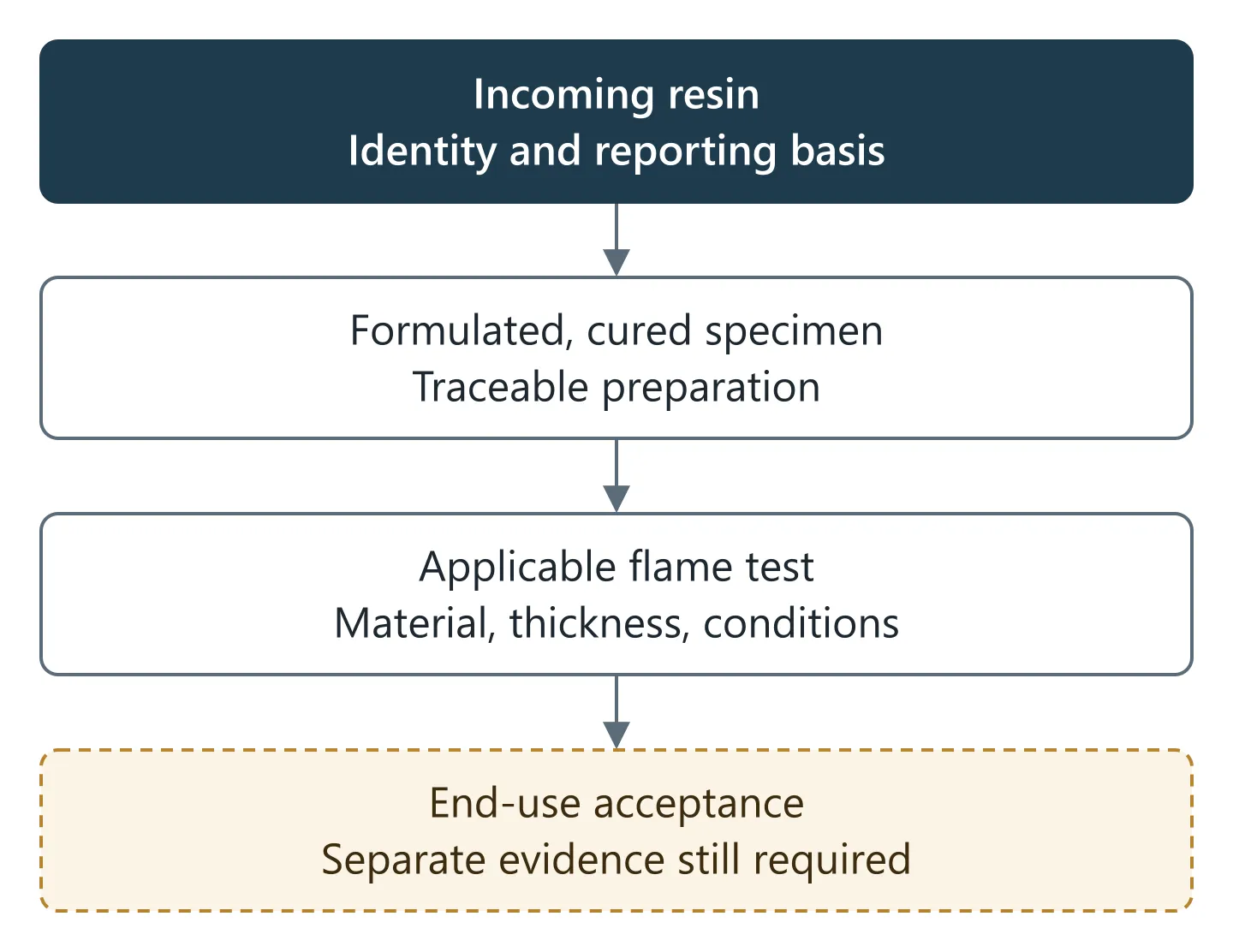
The official UL 94 scope also separates small-scale material testing from acceptance in complete equipment. It does not evaluate an hourly fire-resistance rating for a building system. A coating binder, a cured laminate and an electrical assembly therefore require their own applicable evidence; a familiar V-0 label cannot bridge those scopes on its own.
The diagram is an evidence map, not a test method or an automatic approval sequence. Incoming conformity permits evaluation of an identified material. A controlled formulation trial permits interpretation of that specimen's result. The intended application still determines what further qualification is required.
Make the acceptance decision before committing the order
Write down the requirement that the purchase must satisfy. Is the immediate decision an incoming-resin specification, selection of a formulation for testing, or acceptance for a particular end use? An offer that answers one of these questions may leave the others open.
Hold the affected decision when the reporting basis is unresolved, a report cannot be linked to the offered material, or the specimen and application scopes differ. This does not prove that the resin is unsuitable; it means that the particular conclusion is not supported yet. Agree what evidence will resolve the gap, who evaluates it and the acceptance criteria before extending a successful small trial to a larger order.
For a grade-specific MOS enquiry, provide the intended application, offered or requested supplied form, required analytical bases, and the exact scope of any requested flame classification. Add the sample and order quantities, packaging and destination. Request current TDS/SDS and traceable quality documents, and identify any formulation or end-use evidence still needed. The useful outcome is a material and qualification plan that can be checked—not a phosphorus percentage presented as a finished-product guarantee.